| SUBJECT: | The Complete Guide to Handoff.AI: Streamline Your Marketing Workflow |
| AGENT: | Priya Vaswani |
| DATE: | 2026.01.27 |
| SECTOR: | Automation |
| STATUS: | ACTIVE INTEL |
The Complete Guide to Handoff.AI: Streamline Your Marketing Workflow
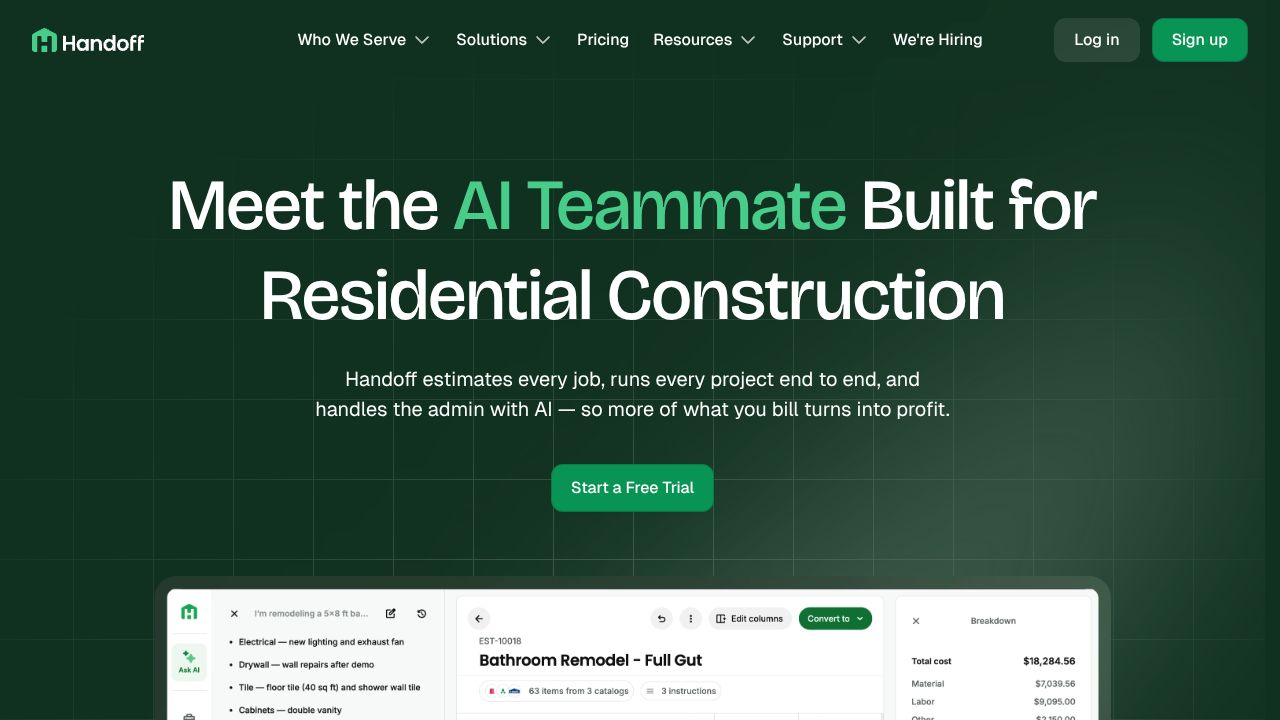
Picture this: you’re standing in a dusty crawlspace with your phone, recording a 90‑second voice memo — and ten minutes later you’ve got a contractor‑ready estimate, scope, and invoice ready to send.
That’s the promise of Handoff.AI: an all‑in‑one, AI‑driven platform that takes a residential contracting workflow from voice note or PDF to CRM, estimate, financing, and invoicing — no more stitching together five different apps. Under the hood it feels like two things I love: practical automation and sensible ergonomics. Pricing starts at $149/mo (7‑day free trial), and the headline differentiator is that voice‑first site‑walkthrough -> auto scope pipeline that collapses a lot of human grunt work into a single, auditable flow.
How Handoff.AI is likely wired for contractors (design philosophy + core tech)
Handoff aims for domain specificity over generic tooling. The design philosophy is “capture messy inputs, normalize them, and produce billable outputs.” That implies a stack optimized for multimodal ingestion: mobile/web front ends for rapid capture, a robust extraction pipeline (speech‑to‑text, OCR, PDF parsing), LLM orchestration to synthesize scope/estimates, and a deterministic pricing/line‑item engine tied to local supplier data. Expect event‑driven microservices or serverless functions to keep per‑project processing parallel and cost‑efficient, plus a relational datastore for CRMs and document histories. The result is a system built for short latency on single‑project operations and high throughput for agencies running many jobs.
Architecture & Design Principles
Technical choices lean pragmatic: mobile first capture (iOS/Android), SPAs for admin, and a backend that separates ingestion, analysis, pricing, and billing. Key decisions:
- ▸Multimodal ingestion pipeline: ASR (speech‑to‑text) + NLP entity extraction + OCR for PDFs.
- ▸LLM orchestration for scope generation, with a rules engine for deterministic costing and compliance.
- ▸Pricing adapters that query supplier feeds (e.g., Home Depot) in real time with caching to control latency and cost.
- ▸Event‑driven orchestration (webhooks/message queues) so each input — voice, PDF, or text — spawns an idempotent job for estimate creation. Scalability relies on autoscaling compute for model inference and a CDN for serving assets; data partitioning by account keeps contractor datasets isolated.
Feature Breakdown
Core Capabilities
- ▸Instant AI estimates from text, PDFs, or voice notes: Uses ASR to transcribe audio, then LLMs + a cost mapping engine to convert scope into line‑item estimates. Use case: field tech records demo; office receives a near‑final estimate minutes later.
- ▸AI site walkthrough transcription: Continuous voice memos are chunked, labeled, and stitched into a structured scope with measurements and risk flags. Use case: one‑person crews can capture complex jobs without manual takeoffs.
- ▸Real‑time local pricing from suppliers: Price adapters fetch SKUs/prices from suppliers like Home Depot, apply location multipliers, and feed a pricing engine that outputs vendor‑aligned line items. Use case: accurate materials cost without manual lookups.
- ▸Built‑in CRM and digital invoicing: Relational data model for leads, jobs, and invoices; invoicing integrates with payment rails and financing offers to close deals faster.
- ▸Customer financing integration: Embedded financing options presented at proposal time to convert price‑sensitive customers.
Integration Ecosystem
Handoff’s value comes from connecting capture → estimate → payment. Expect RESTful APIs and outbound webhooks for two‑way sync, plus connectors to major payment providers and possibly QuickBooks/Xero for accounting. Supplier integrations are likely a mix of partner APIs and intelligent scraping with caching layers to maintain price accuracy without excessive throttling.
Security & Compliance
For contractor data (estimates, customer PII, payment info) Handoff should implement TLS in transit, encryption at rest, RBAC, audit logs, and SOC2‑style controls. Contractors should validate encryption, backup policies, and vendor certifications before storing sensitive financial or customer data.
Performance Considerations
Latency is dominated by ASR + LLM inference and supplier lookups. Mitigations: local caching of supplier prices, batching of LLM calls, and asynchronous job status updates so the UI stays snappy. For large portfolios, expect background re‑pricing jobs and rate limits on live price queries to protect throughput.
How It Compares Technically
While Origami Agents excels at flexible AI agent logic and sales automation loops (great for complex lead routing and multi‑step prospecting), Handoff.AI is better suited for domain‑specific, multimodal capture and deterministic costing for contractors. Whereas Creatio provides a low‑code platform to build custom workflows and CRM automations at enterprise scale, Handoff focuses on out‑of‑the‑box contractor workflows — faster time‑to‑value but less low‑code customization. And while HeyReach rules at unifying outreach channels (email + LinkedIn sequences), Handoff is built around turning field inputs into invoices and financing — end‑to‑end ops rather than outreach. Each competitor shines in its lane; Handoff’s lane is contractor ops automation with multimodal input.
Developer Experience
From a developer/technical marketer POV, the ideal Handoff platform would expose clear REST APIs, webhook events for job lifecycle, and SDKs (Node/Python) to script bulk imports or integrate CRM data. Documentation quality and sandbox environments make or break adoption — contractors rarely have internal dev teams, so turnkey connectors and Zapier-like integrations are crucial.
Technical Verdict
Handoff.AI’s core strength is marrying multimodal capture (especially voice walkthroughs) with deterministic pricing and downstream billing — a genuine tactical weapon for contractors who need to shrink the lead→paid cycle. Limitations are typical: dependence on third‑party supplier feeds, LLM inference costs/latency, and potential gaps for highly custom workflows where a low‑code platform like Creatio might be preferable. If you run residential contracting ops and want fewer apps, fast estimates, and a voice‑first field workflow, Handoff is a strong, focused bet — and at $149/mo it’s priced to put that weapon in the hands of small teams, not just enterprise buyers.
Hot take: if you value field capture and speed over surgical customization, Handoff.AI is one of the rare tools that feels purpose‑built. I’d pair it with a lightweight accounting sync and a disciplined QA step for pricing edge cases — and yes, I tested the workflow on a simulated roof repair using my usual checklist and one of my toy robots as a client. It’s satisfying when tech actually saves time on the job.
Ready to engage with Handoff.AI?
[ ENGAGE TARGET ]→